Ghost Ranch & Abiquiú Photography Guide
Photographing Georgia O'Keeffe's Landscapes in Fall Colors
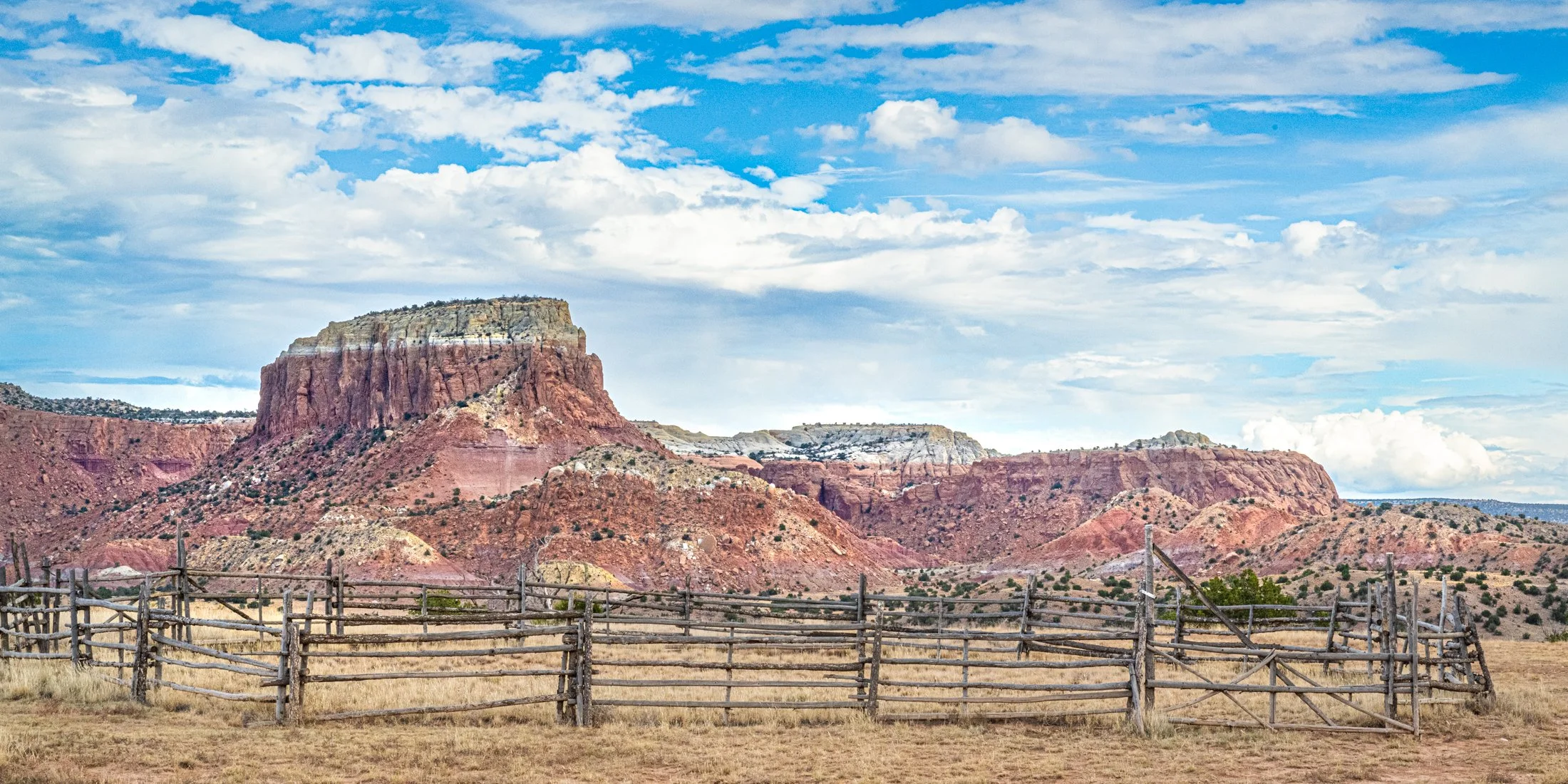
The corral from the City Slickers movie set at Ghost Ranch | ISO 1250, 70mm, f/22, 1/125 sec
In case you were wondering …
What are the best photography spots at Ghost Ranch?
The most iconic photography locations at Ghost Ranch include Chimney Rock (best at sunset), Kitchen Mesa, and the City Slickers Corral. For Georgia O'Keeffe’s famous landscapes, photograph Cerro Pedernal from the hairpin turn going to the upper lodging. In October, the Rio Chama Overlook offers incredible views of golden cottonwoods against the red cliffs.
Before I get to the photos, here are some exact details:
| Location / Subject | GPS Coordinates | Best Time & Light | Recommended Lens | Access / Hike Difficulty |
|---|---|---|---|---|
| Santa Rosa de Lima Ruins | 36.210016, -106.290615 | Mid-Afternoon Adobe walls glow warm orange |
24-70mm / 70-200mm Frame ruins with mountains |
Easy (Roadside) Dirt pullout off US-84 |
| Plaza Blanca Gate Entry | 36.223349, -106.299191 | Midday or Overcast White rock reflects light into canyons |
Wide Angle (14-24mm) Get close to formations |
Easy Hike (Regulated) Requires gate code registration |
| Rio Chama Overlook | 36.237626, -106.392895 | Mid-Afternoon Sun illuminates the river valley |
70-200mm + Polarizer Compress river, trees, and cliffs |
None (Roadside) Pullout on US-84 (Mile 224) |
| Ghost Ranch Entry Mesa View | 36.313850, -106.481602 | Afternoon Warm side-light highlights textures |
24-70mm Include sagebrush foreground |
None (Roadside) Park at entrance pullout |
| City Slickers Corral | 36.318883, -106.480099 | Afternoon / Late Afternoon Red butte behind it glows red |
24-70mm Capture full corral and butte |
Easy Walk Located near ranch headquarters |
| Chimney Rock Trail End | 36.338412, -106.483704 | Sunset / Golden Hour Catch the last light on the spire |
70-200mm Isolate against cliff background |
Moderate (3mi RT) Or shoot from the road with telephoto |
| Cerro Pedernal Shot Location | 36.332485, -106.472932 | Sunrise & Sunset Silhouette shots or golden light |
100-400mm It is distant; zoom is essential |
None (Roadside) Shoot from US-84 or Ranch scenic drive |
| Kitchen Mesa Trail End | 36.335588, -106.463933 | Late Afternoon Cliffs glow at as sun highlights |
Wide Angle (16-35mm) For sweeping views from top |
Strenuous (4mi RT) Requires scrambling; or shoot from base |
🎨 Ghost Ranch & Abiquiú Quick Facts
Location: Abiquiú, NM (65 miles NW of Santa Fe, 90 miles N of Albuquerque)
Drive Time from ABQ: 1.5 hours via US-84/285 North
Ghost Ranch Entry: $10/adult day pass | $5/child (5-11) | Free under 5
Hours: 9:00 AM - 4:00 PM daily
Best Time to Visit: Early-mid October (fall colors) | Late afternoon (3-6 PM)
Time Needed: Half day minimum (6+ hours with driving)
Elevation: ~6,100 feet
Essential Gear: 24-70mm, 70-200mm, polarizing filter
🍂 Fall Colors Peak: First two weeks of October for golden cottonwoods
Standing Where Georgia O'Keeffe Stood
Abiquiú (pronounced Ah-bih-cue) isn't just a location on a map—it's a pilgrimage site for anyone who has ever been moved by Georgia O'Keeffe's paintings. This is the landscape that stopped one of America's greatest artists in her tracks and held her for fifty years.
In 1934, O'Keeffe first visited Ghost Ranch and wrote to her husband Alfred Stieglitz: "I wish you could see what I see out the window—the earth pink and yellow cliffs to the north—the full pale moon about to go down in an early morning lavender sky." She would return every summer for the rest of her life.
What drew her—and what will captivate you as a photographer—is the geological collision happening here. Abiquiú sits at the junction of two massive geological provinces: the Rio Grande Rift (a tectonic "drop" in the earth) and the Colorado Plateau (a massive "uplift"). The result? Layer upon layer of exposed rock in colors you wouldn't believe if you hadn't seen them yourself.
This guide will show you where to photograph the landscapes O'Keeffe painted, when to catch the golden cottonwoods, and how to capture the "raking" light that makes this terrain glow.
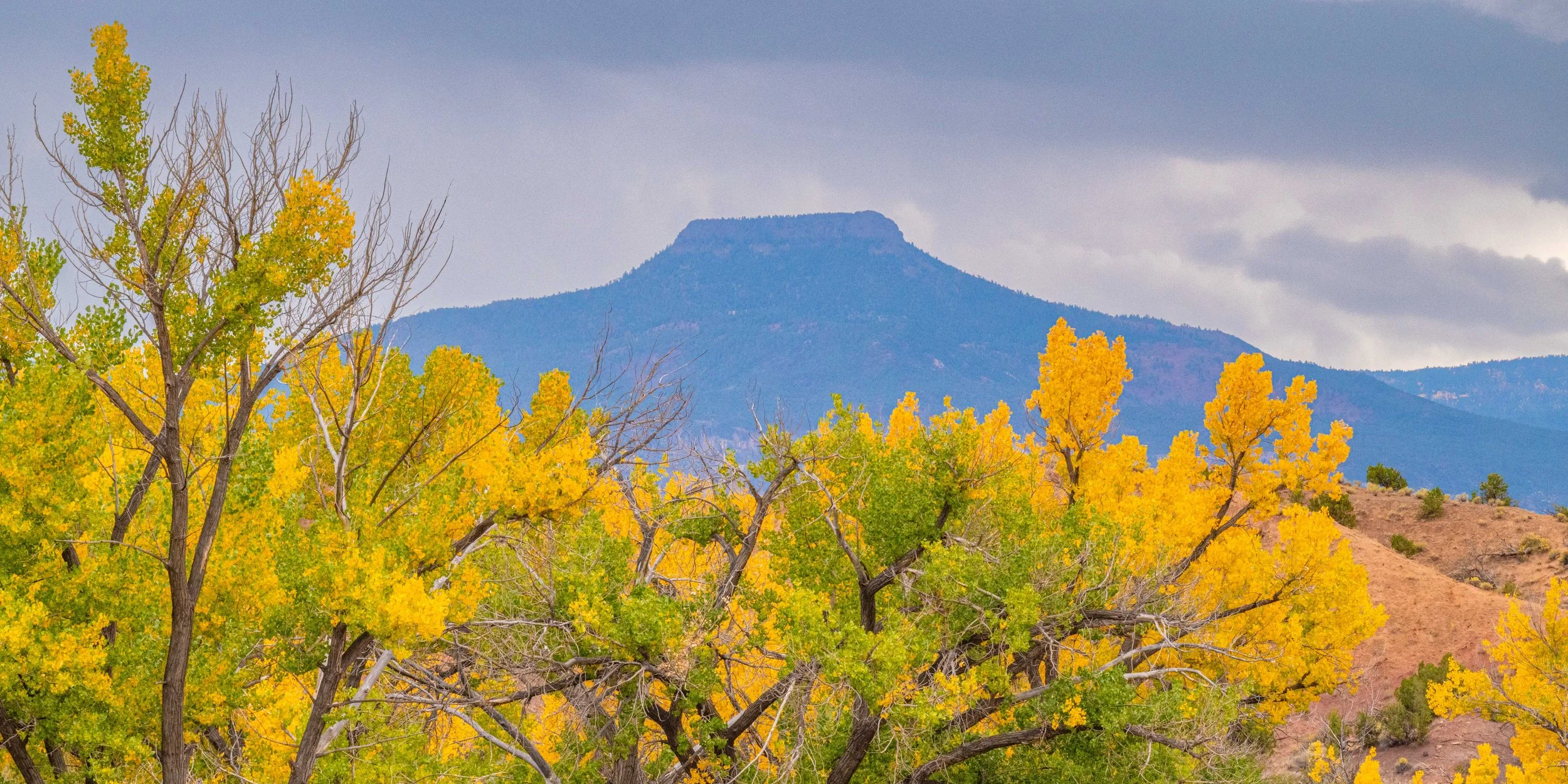
Cerro Padernal at dusk with a storm rolling in and golden Cottonwood trees in the foreground | ISO 1000, 200mm, f/22, 1/160
What Makes Ghost Ranch & Abiquiú Special for Photographers?
The Geology: A 300-Million-Year Color Palette
You're not just photographing "colorful rocks." You're capturing 300 million years of Earth's history exposed in vertical layers:
Deep Maroon/Red: Permian-age Cutler Formation (280-300 million years old)
Electric Yellow/Purple: Triassic Chinle Group shales (200-230 million years old)
Creamy White/Tan: Jurassic Entrada Sandstone (150-160 million years old)
Pink/Salmon: Various mudstones and siltstones
For Photographers: This means you're working with a color palette that rivals a painter's studio. The strata are clearly defined, creating natural horizontal lines and compositional elements.
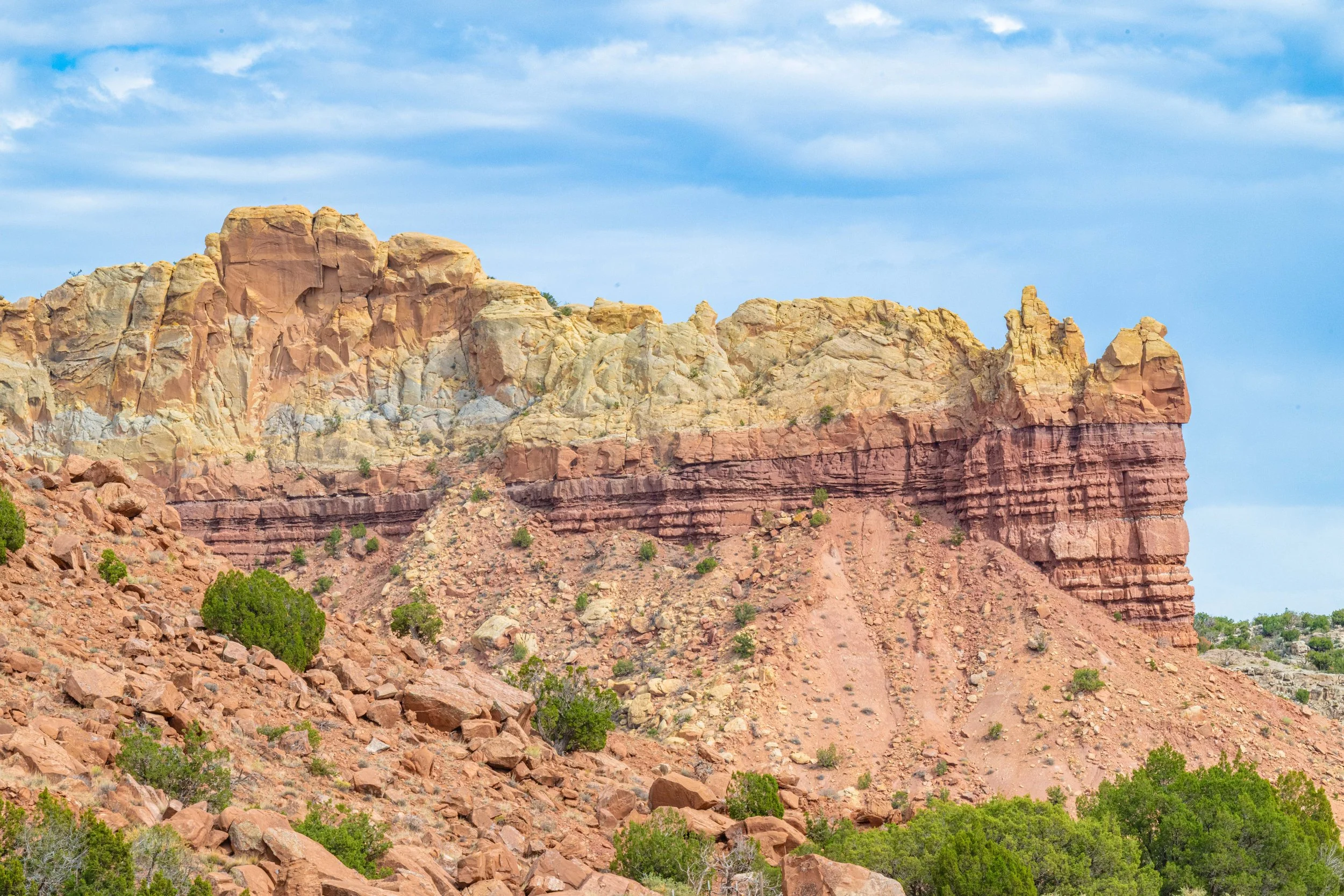
300 million years of earth’s history stratified in a single frame | ISO 400, 175mm, f/22, 1/160
The Light: Crystalline and Raking
At 6,100 feet elevation with extremely dry air, the light at Abiquiú has what photographers call a "raking" quality. It doesn't just illuminate—it carves. Every crack, every ripple, every geological layer becomes emphasized.
Technical Explanation: The high altitude and low humidity mean less atmospheric scattering. Light travels through less dense air, maintaining its directionality. When this directional light hits the undulating cliff faces at an angle (as it does in late afternoon), shadows become deep and textures pop.
Post-Processing Tip: You'll barely need to touch the Clarity slider in Lightroom. Just a +5 to +10 adjustment and the details will explode.
The Fall Colors: Gold Against Red
In early to mid-October, the cottonwood trees in Abiquiú turn a blinding, electric gold. When photographed against the red and purple cliffs, with deep green sagebrush in between, you get a color combination that seems impossible—yet there it is.
Why This Matters: Most fall color photography involves forests. Here, you get layered fall colors of flora and geology: gold ribbons of cottonwoods sandwiched between red cliffs and green vegetation, all under cerulean blue skies.
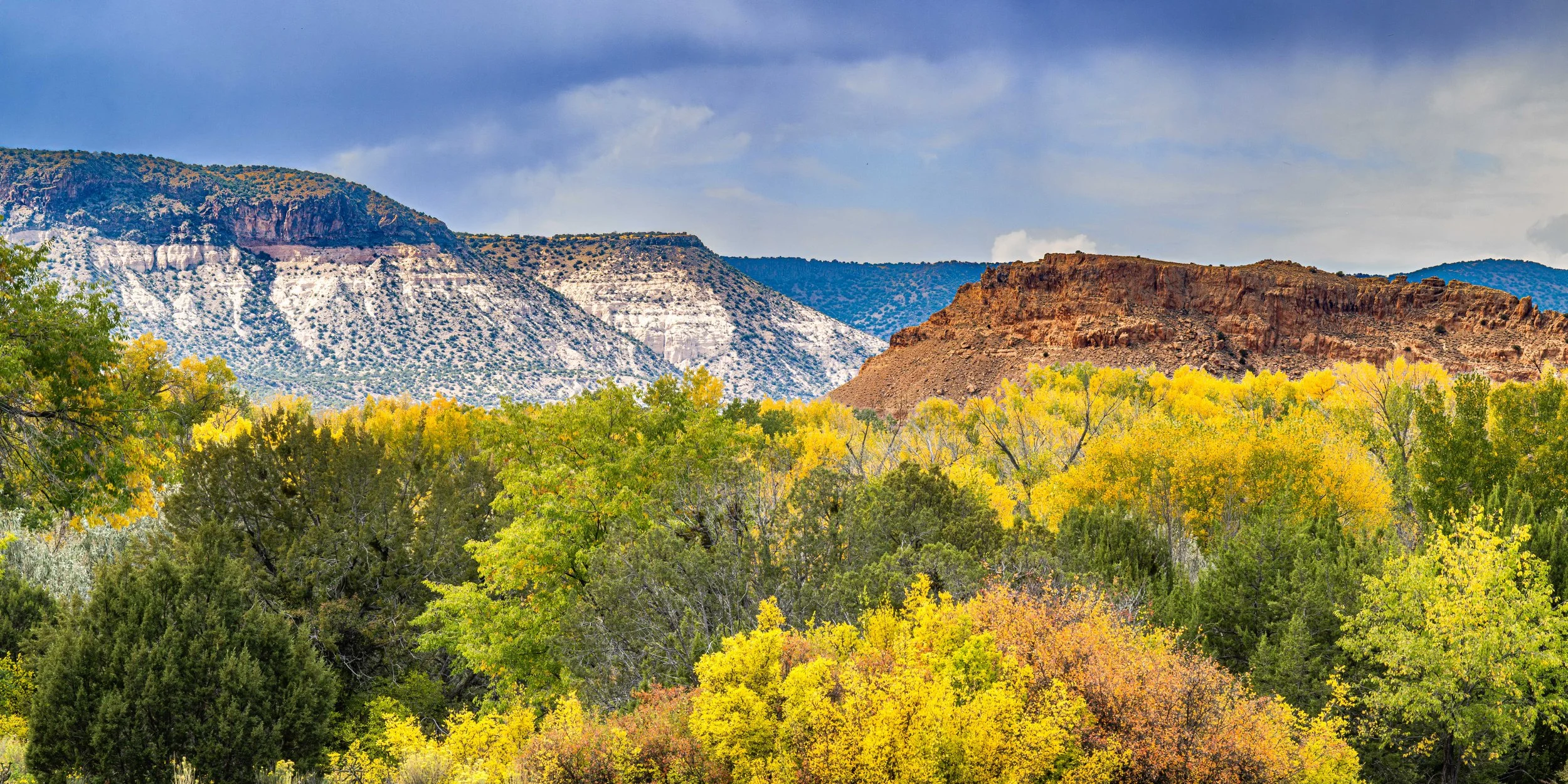
Abiquiú New Mexico strom clouds and fall colors | ISO 250, 200mm, f/22, 1/50
Georgia O'Keeffe's Legacy
O'Keeffe didn't just paint here—she acted as an "environmental alchemist," stripping the landscape down to its essential forms. Her famous paintings of Pedernal ("my private mountain"), the red hills, and the white place taught generations to see abstract beauty in natural forms.
For Photographers: Standing where she stood, seeing what she saw, offers a masterclass in compositional minimalism. Look for what she looked for: form, color relationships, negative space, the interplay of organic and geometric shapes.
Essential Locations: Where to Photograph in Ghost Ranch & Abiquiú
1. Ghost Ranch Entry Mesa (MUST-SHOOT)
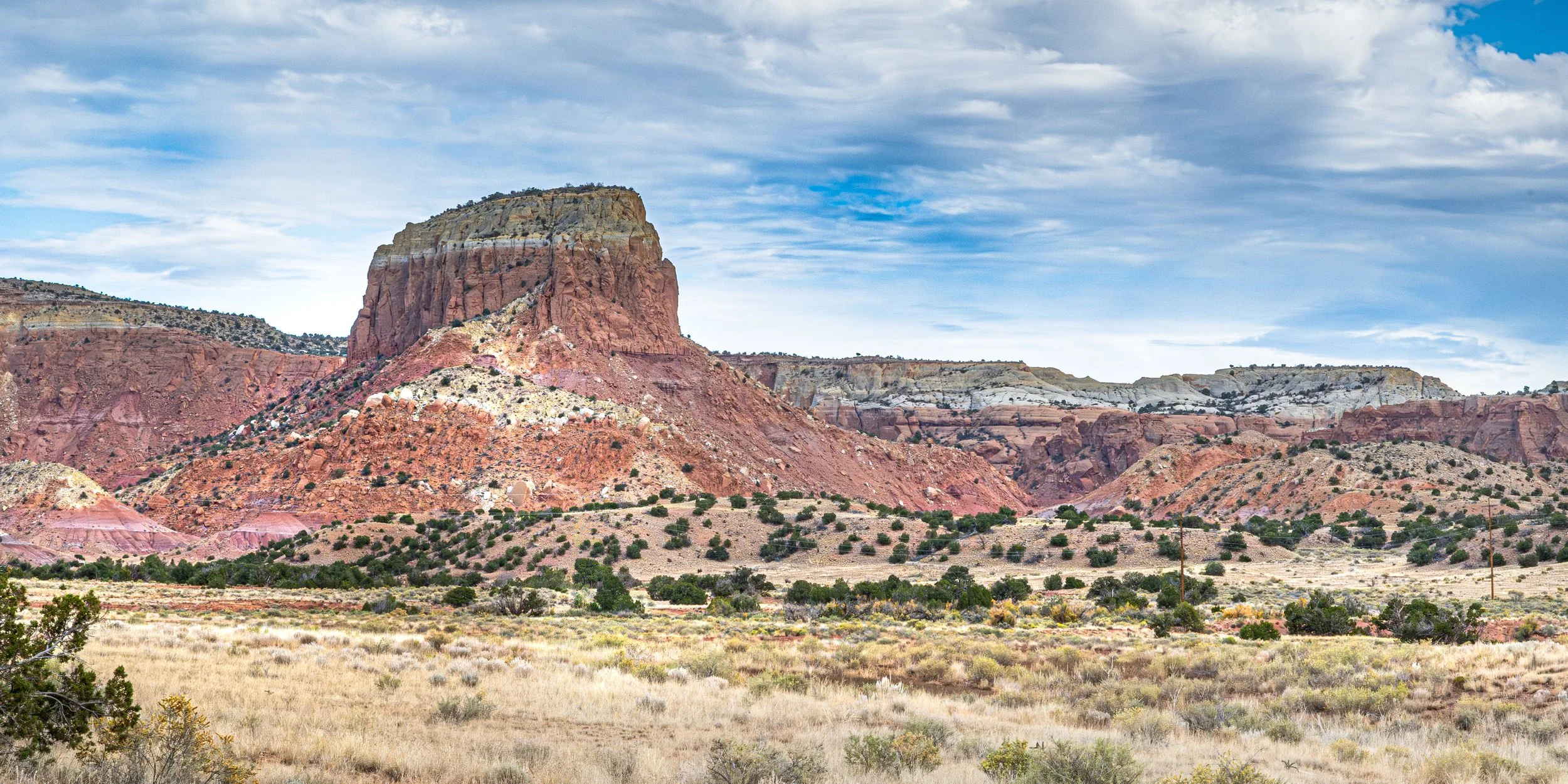
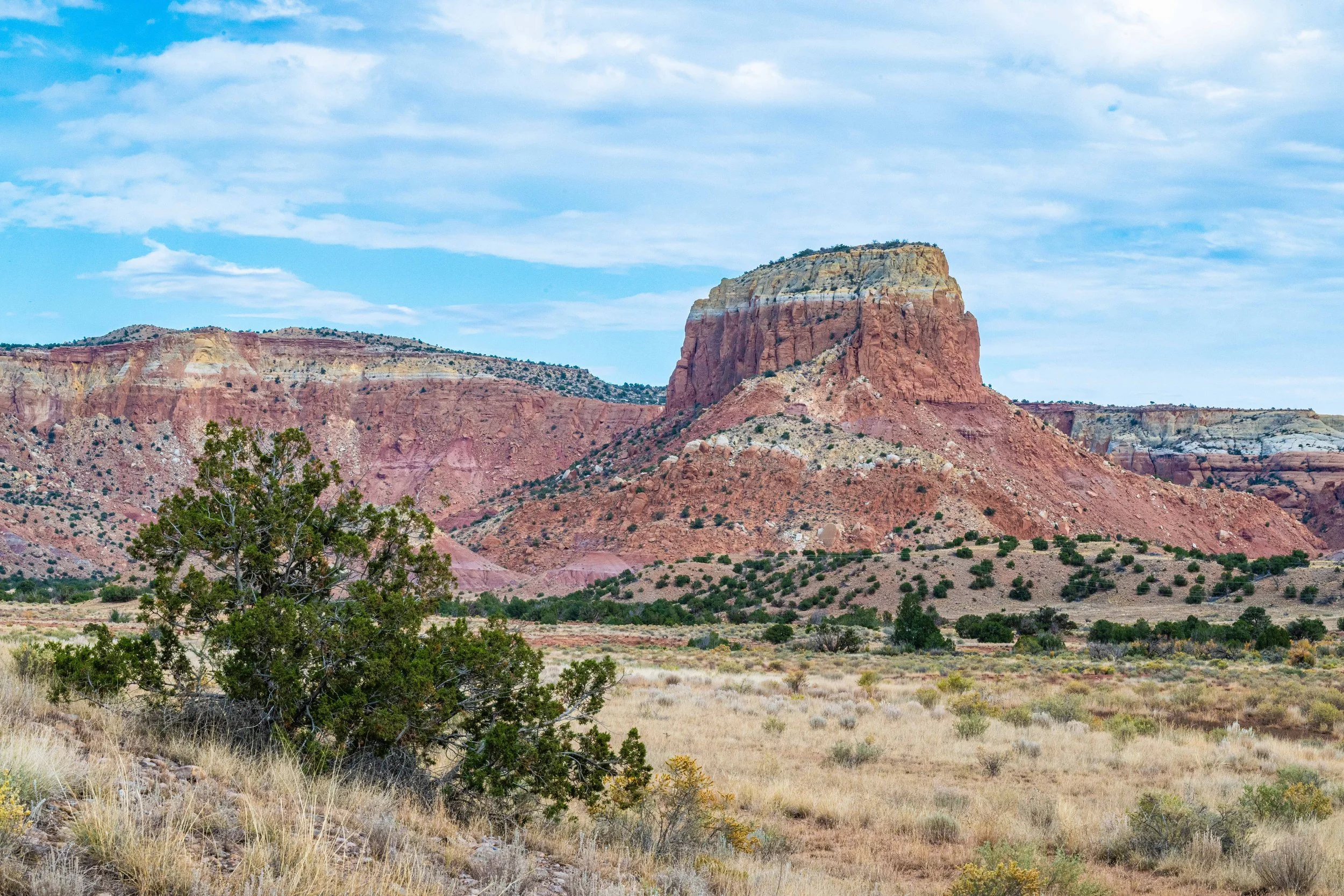
Location: Immediately as you turn into Ghost Ranch driveway from US-84
Before you even reach the guard shack, look to your RIGHT. You'll see a stunning mesa formation with multiple colored geological layers. IMO, this is one of the most photographable spots in the entire area. There is an annoying small pole that sticks up in front of the mesa / butte that I cloned out (full transparency).
What Makes It Special:
Multiple geological layers clearly visible
Red, yellow, purple, and white strata
Eroded formations create interesting shapes
Easy access (small parking area on the right)
Camera Settings:
Lens: 70-200mm (compress layers) or 24-70mm (include foreground)
Aperture: f/8-f/22
ISO: 100-400
Polarizer: If you’d like (deepens sky, reduces rock glare). Above image not polarized
Best Light: Afternoon (2-6 PM). Front of formation and hills illuminated
2. Rio Chama River Overlook (FALL COLORS SPOT)
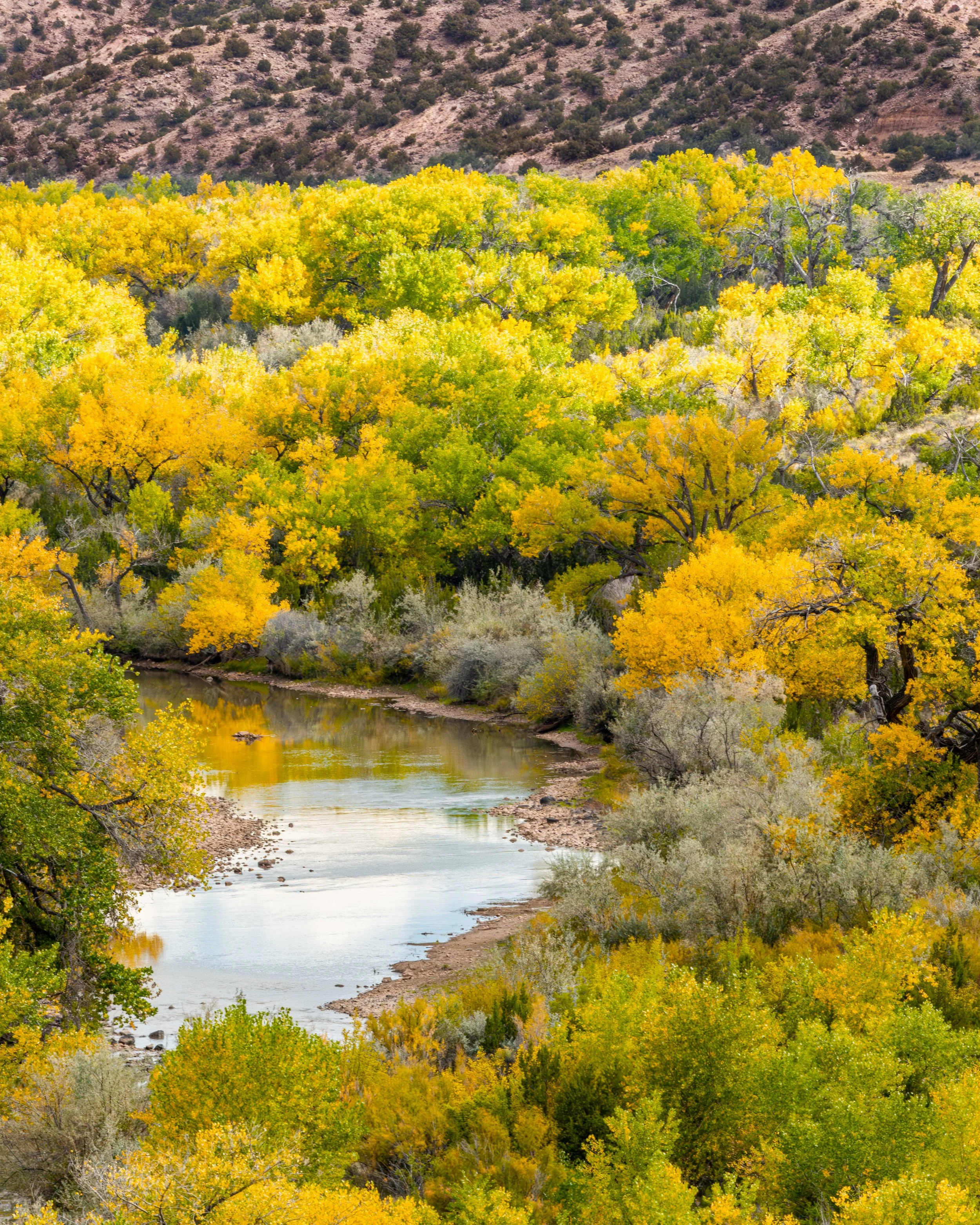
Rio Chama Overlook on Rte. 84
Be sure to stop at this pullout as you near Ghost Ranch, New Mexico
ISO 1250, 400mm, f/22, 1/320
Location: US-84, approximately Mile Marker 224 (21535A US-84, Abiquiu, NM 87510)
Timing: October 1-15 for peak cottonwood color
This overlook provides an elevated view of the Rio Chama as it winds through the valley. In October, the cottonwood trees lining the river turn gold, creating a ribbon of color between red cliffs and green sagebrush.
The Shot: Frame the composition with three horizontal layers:
Foreground: Dark green sagebrush
Middle: Golden cottonwood ribbon following the river
Background: Red/purple cliffs and blue sky
Camera Settings:
Lens: 70-200mm (compress the layers)
Aperture: f/8-f/11 (front-to-back sharpness)
ISO: 100-200
Polarizer: Essential (deepens sky, saturates foliage)
Pro Tip: Use a polarizer and rotate until the sky reaches maximum saturation. The color contrast between gold, green, red, and blue will be jaw-dropping.
3. Chimney Rock at Ghost Ranch (ICONIC FORMATION)
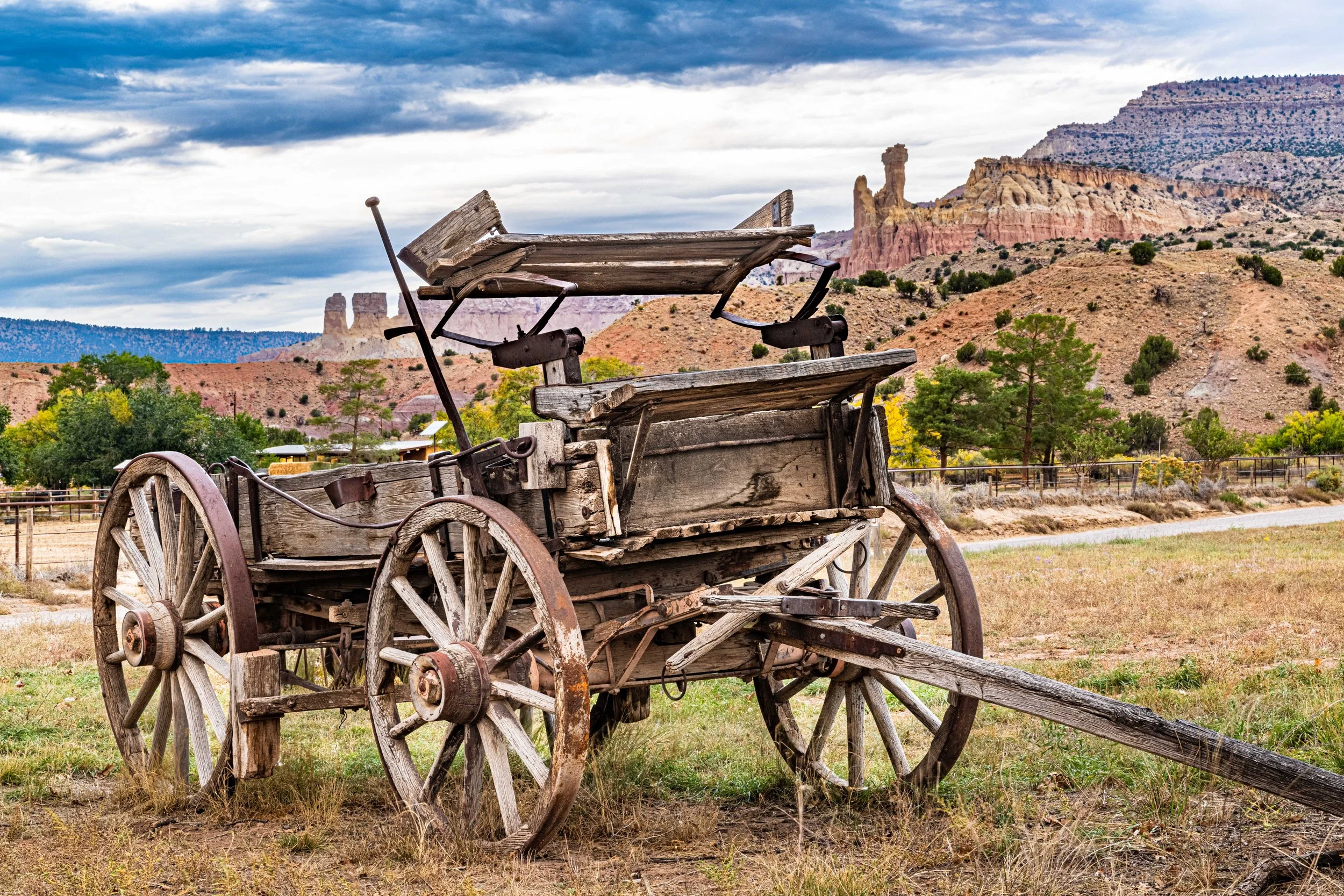
An old wagon with Chimney Rock in the background | ISO 250, 70mm, f/20, 1/6 sec
Location: Visible from Ghost Ranch entrance road, left (north) side
Chimney Rock is one of Ghost Ranch's most recognizable formations—a tall, isolated spire rising from the valley floor. O'Keeffe painted it multiple times.
How to Photograph It:
From the road: Shoot from various points along the entrance drive
Chimney Rock Trail: 3-mile round-trip hike for closer views (moderate difficulty)
Sunset angle: Position west of the formation to catch rim lighting
Best Composition: Use the multicolored cliffs behind Chimney Rock as a backdrop. The reds, yellows, and purples create a natural color graduation.
Camera Settings:
Lens: 70-200mm (isolate the spire)
Aperture: f/5.6-f/8
Telephoto Compression: Use 135-200mm to compress Chimney Rock against the colorful background cliffs
Best Light: Late afternoon or early morning
4. Kitchen Mesa (East-Facing Formation)
Location: Behind Ghost Ranch guard shack, visible from the parking area
Kitchen Mesa is a flat-topped formation on the east side of Ghost Ranch. It's best photographed from the road that loops above the visitor center.
Access:
Drive the loop road above the Welcome Center
Multiple pullout points with mesa views
Kitchen Mesa Trail (moderate 4-mile round-trip hike)
Best Light: Morning (8-10 AM) or late afternoon (4-6 PM)
5. Pedernal Mesa (O'Keeffe's "Private Mountain")
Location: Visible from multiple points in the area
Georgia O'Keeffe famously said, "It's my private mountain. God told me if I painted it enough, I could have it." Pedernal (pronounced "Peh-der-NAHL") is a distinctive flat-topped mesa visible for miles.
Best Viewpoints:
Ghost Ranch hillside drive: Elevated views from the road above the visitor center
Abiquiu Lake: Distant view with lake foreground (15 miles north)
Along US-84: Multiple roadside pull-offs between Abiquiú and Ghost Ranch
The Shot: Use a telephoto lens (70-200mm) to isolate Pedernal against the sky. Shoot during golden hour when the flat top catches warm light while the face is in shadow—this creates the dramatic two-tone effect O'Keeffe loved.
Pro Tip: In October, find compositions that include golden cottonwoods in the foreground with Pedernal in the background.
5. Plaza Blanca "The White Place" (ADVANCED PERMIT REQUIRED)
Location: ~3.6 miles from Ghost Ranch (342 Co Rd 155, Abiquiu, NM 87510)
Access: Requires advance online registration at daralislam.org to receive gate code. Access is FREE but regulated.
Plaza Blanca is a labyrinth of white volcanic ash and limestone spires—the location of O'Keeffe's famous "White Place" paintings. The formations are otherworldly: towering white cliffs, narrow slot canyons, and sculpted hoodoos.
Photography Approach:
Frames within Frames: Use the narrow canyon walls to frame distant formations or blue sky
Texture: The white limestone has a "cauliflower" texture that's incredibly photogenic
Exposure: Underexpose or dial down EV by -0.5 to -1 stop. The white rock is a giant reflector and will blow out if you trust auto-metering
Contrast: The white limestone against deep blue October sky is stunning
Camera Settings:
Lens: 24-70mm (versatile for tight spaces and wider vistas)
Aperture: f/8-f/16 (maximize detail in the limestone texture)
ISO: 100-400
Exposure Compensation: -0.5 to -1 stop (preserve highlight detail)
Best Light: Late afternoon or overcast days (harsh midday sun can be too bright)
⚠️ Important Rules:
Register online BEFORE visiting (gate requires code)
This is sacred land—treat it with utmost respect
No drones without special permission
Pack out all trash
Stay on established paths where possible
6. City Slickers Corral (Movie Set)
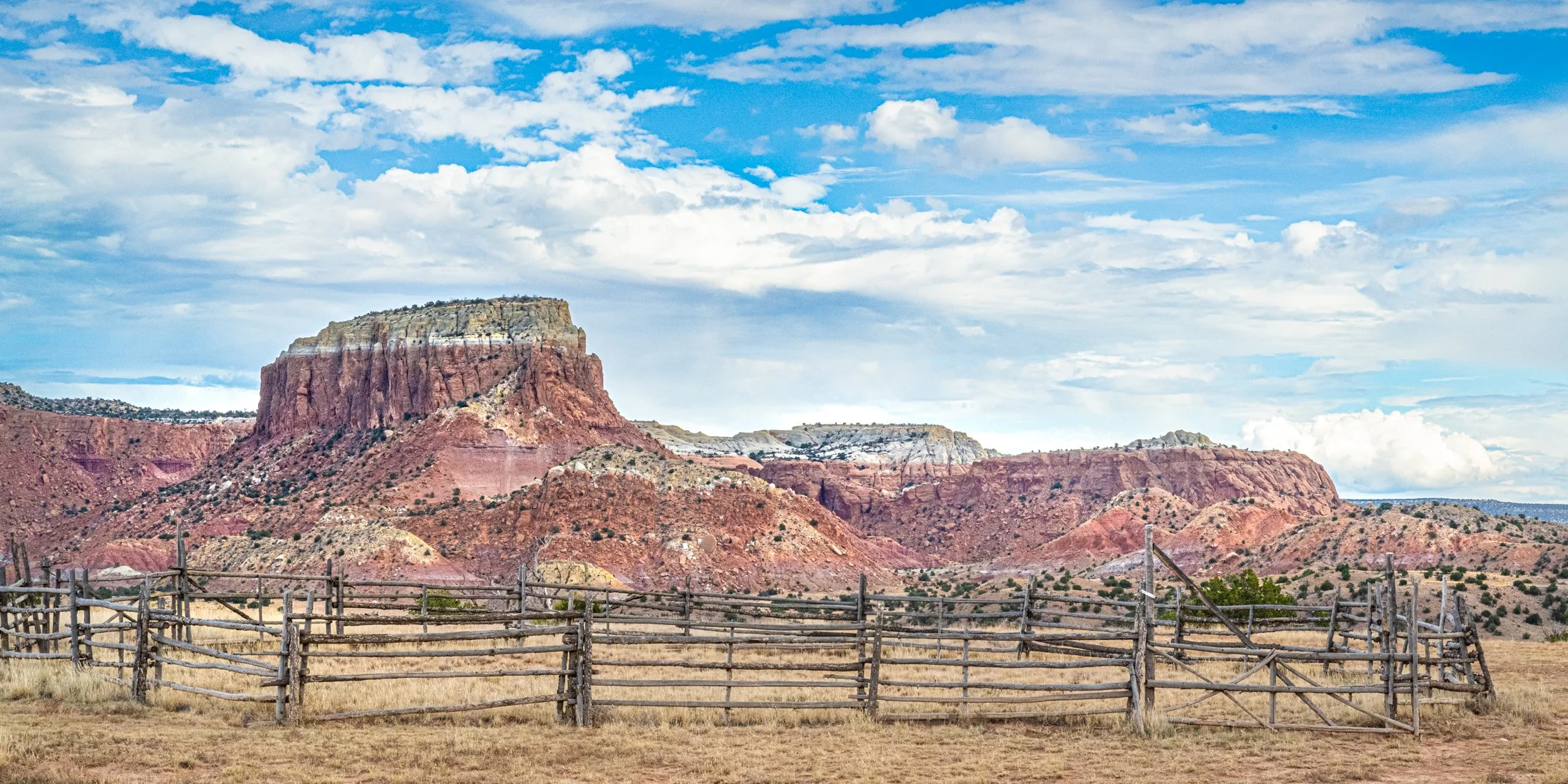
City Slickers Corral with entryway mesa | | ISO 1250, 70mm, f/22, 1/125 sec
Location: About 0.5 miles into Ghost Ranch driveway, on the right
This is the actual corral used in the 1991 movie "City Slickers" starring Billy Crystal. The rustic wooden corral sits against a stunning backdrop of colorful cliffs.
The Shot: Classic Western composition—weathered wood fence in foreground, dramatic cliffs in background. Best in late afternoon when the cliffs glow.
7. Route 84 Roadside Photography
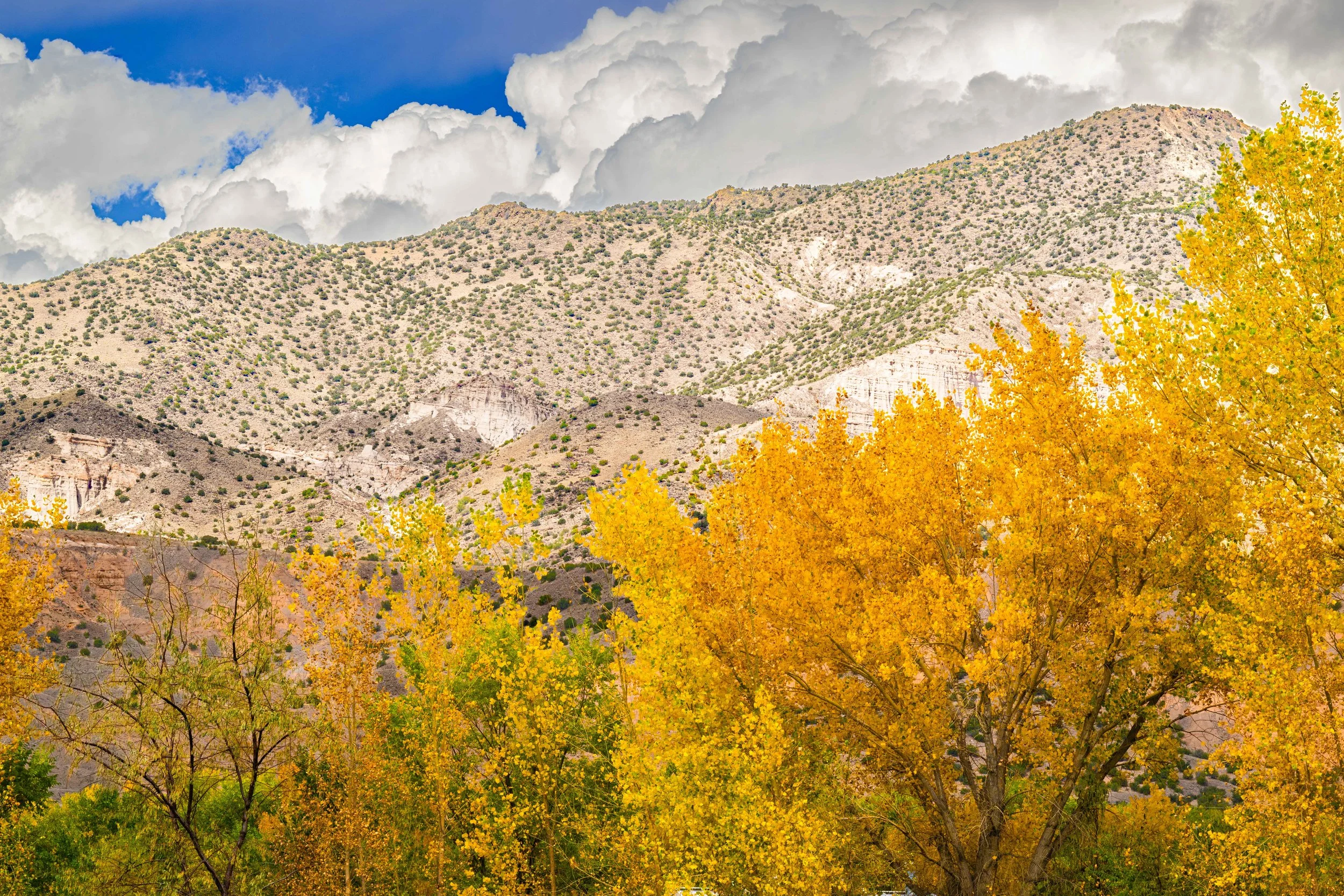
Stunning roadside scene along Route 84 on the way to Abiquiu | ISO 250, 175mm, f/22, 1/80 sec
Strategy: US-84 between Española and Ghost Ranch is studded with incredible geological formations, many visible from roadside pullouts.
Notable Stops:
Chinle Formation exposures: Electric purple and yellow badlands
Santa Rosa de Lima: Ruins of 1734 adobe church with white rock backdrop
Various cottonwood groves: Golden trees against red cliffs in October
Pro Tip: Whatever time your GPS says the drive will take, add at least one hour for photography stops. You WILL want to pull over repeatedly.
Photography Techniques for Ghost Ranch
Working with the Layered Colors
Ghost Ranch's geology creates natural horizontal color bands. Use this to your advantage:
Telephoto Compression: Use 135-200mm to compress multiple colored layers into a single frame
Rule of Thirds: Place the most vibrant color band along one of the thirds lines
Color Relationships: Look for complementary colors (red/green, yellow/purple) stacked vertically
Minimize Sky: Unless the sky is spectacular, keep it to 1/4 of the frame or less—the cliffs are the star
Dealing with High Contrast
The brilliant cliffs against deep blue skies create extreme contrast. Solutions:
Polarizing Filter: Reduces glare on rock surfaces, deepens sky
Bracket Exposures: Shoot 3-5 frame brackets for post-production blending
Expose for Highlights: Let shadows go dark—the cliffs should be properly exposed
Use Golden Hour: Lower contrast during sunrise/sunset makes single exposures work
Compositional Approaches
The O'Keeffe Method: Minimalism
Eliminate distractions
Focus on form and color relationships
Use negative space (sky) to balance positive space (cliffs)
Abstract the landscape—let it become about shape and color, not literal representation
Foreground Elements:
Weathered fence posts
Sagebrush
Cottonwood trees (especially golden ones in October)
Dried grasses
Rock formations in foreground leading to distant cliffs
Working with the Crystalline Light
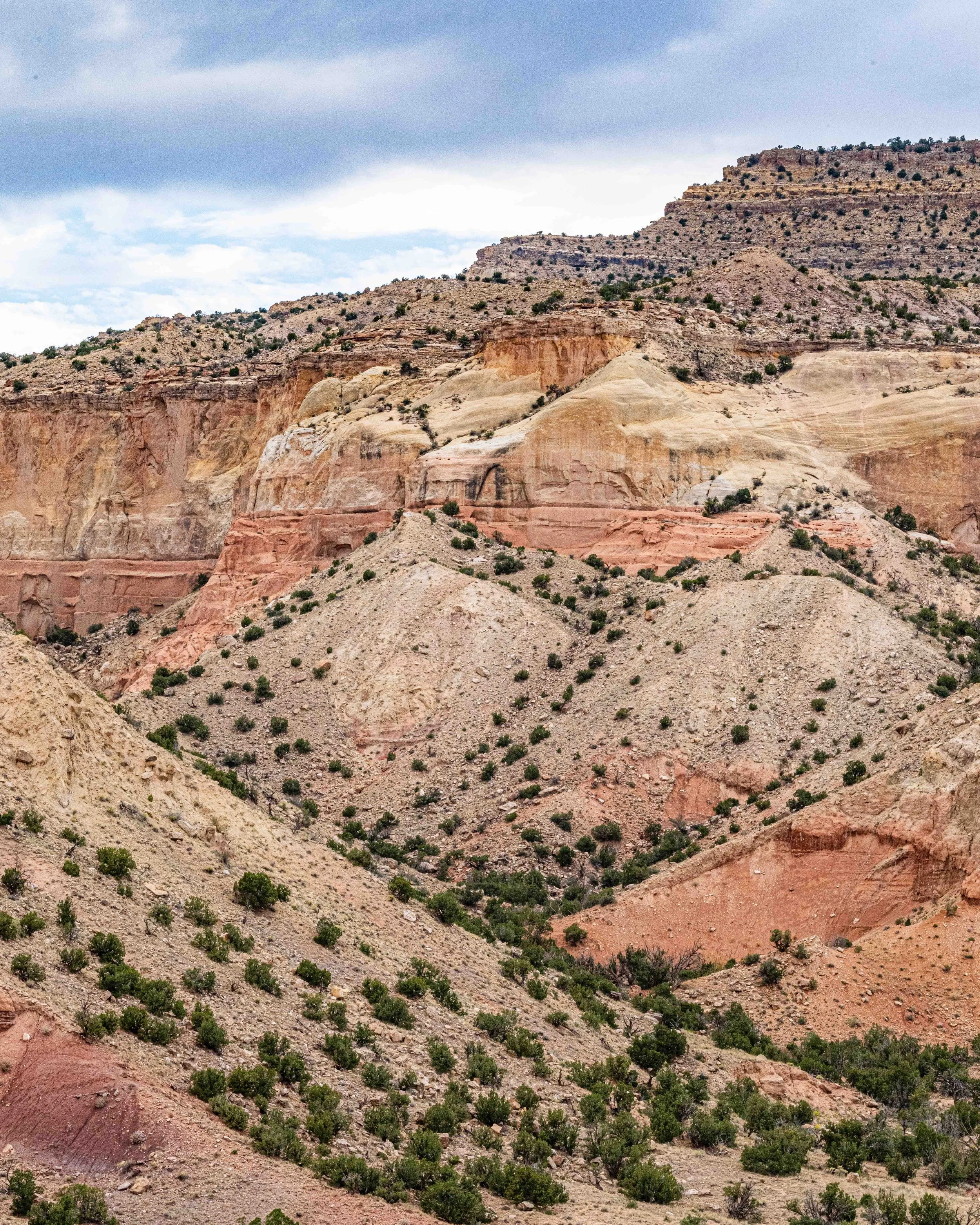
Crystalline Light adds incredible clarity to Ghost Ranch Photos - even with gray thunderclouds blocking the sun!
ISO 1000, 115mm f/22, 1/160
The high-altitude, dry air creates incredibly clear light. In post-processing:
Minimal Clarity Needed: don’t push too far to keep things looking natural
Texture Slider: Very effective on the striated cliff faces
Vibrance over Saturation: The colors are already intense—if you’re shooting in RAW use vibrance for subtle enhancement. If you’re shooting JPG you’ll likely not need to make many adjustments at all.
Shadow Lifting: Moderate shadow recovery reveals detail without looking HDR-ish. Use filters to target particularly deep shadows.
Essential Photography Gear for Ghost Ranch
Lenses: The Perfect Kit
Primary: 24-70mm f/2.8
Versatile for wide scenes and tighter compositions
Great for roadside shooting where you can't control your distance
Works well in slot canyons at Plaza Blanca
Secondary: 70-200mm f/2.8 or f/4
Essential for compressing layered cliff formations
Isolating Chimney Rock or Pedernal
Capturing distant details
Creating abstract compositions of color bands
Optional: 16-35mm or 14-24mm
For dramatic wide-angle perspectives at Plaza Blanca
Emphasizing foreground elements with dramatic cliff backdrops
Filters
Polarizing Filter:
Deepens the blue sky dramatically
Reduces glare on rock surfaces
Saturates the colors of cliffs and vegetation
Beneficial for October cottonwood photography
Graduated ND Filter:
Useful when the sky is much brighter than cliffs
2-stop or 3-stop works well
Support Gear
Tripod: Recommended but not always necessary (good light in afternoon)
Remote Trigger: If using tripod for long exposures
Recomnended Hiking Trails at Ghost Ranch
| Trail Name | Distance & Time | Difficulty & Elev. | Photographic Highlights |
|---|---|---|---|
| Chimney Rock Trail |
3.2 miles (Round-trip) 2-3 Hours |
Moderate +600 ft gain |
Up-close views of the Chimney Rock spire; panoramic valley views from the ridge (great at sunset). |
| Kitchen Mesa Trail |
4.0 miles (Round-trip) 3-4 Hours |
Mod to Strenuous +1,000 ft gain |
Spectacular summit views of the entire Ghost Ranch basin; wildflowers in spring; cliff edge compositions. |
| Box Canyon Trail |
1.0 mile (Round-trip) 30-45 Minutes |
Easy Minimal gain |
A scenic walk into a box canyon; excellent for detail shots of rocks and texture; family-friendly. |
Trail Tips:
All trails start from Ghost Ranch property (day pass required)
Bring plenty of water (1-2 liters per person)
Wear sturdy hiking boots
Apply sunscreen—high altitude sun is intense
Check in at Welcome Center before hiking
When to Visit Ghost Ranch & Abiquiú
Best Season: Early-Mid October (Fall Colors)
Peak Time: October 1-15 typically offers the best combination of:
Golden cottonwood trees along the Rio Chama
Pleasant temperatures (daytime 65-75°F)
Clear, stable weather
Lower tourist crowds than summer
Color Timing: The cottonwoods are temperature-dependent. A cold snap in late September can trigger the color change. Warm September weather can delay it until mid-October. Check local reports or call Ghost Ranch (505-685-1000) for current conditions.
Entry Fees & Passes
Ghost Ranch Day Pass:
Adults: $10
Children (5-11): $5
Children under 5: Free
Advance Reservations: Preferred (call 505-685-1000 or visit website)
O'Keeffe Landscape Tour:
Adults: $42
Children (5-17): $25
Duration: ~2 hours
Booking: Reserve online or by phone
What It Includes: Guided tour to specific locations O'Keeffe painted, stories about her time at Ghost Ranch
Note: The O'Keeffe Landscape Tour accesses private areas not available to day pass holders. However, for pure photography, the day pass gives you more flexibility.
Hours & Seasons
Welcome Center: 9:00 AM - 4:00 PM, Monday-Saturday (closed Sundays)
Trails: Accessible during daylight hours
Museums: Hours vary, check website
Best Season: October (fall colors), April-May (wildflowers), September (pleasant weather)
How to get to Ghost Ranch - Albiquiu
From Albuquerque: 90 miles (1.5 hours)
Take US-285 North to Española
Continue on US-84 Northwest toward Abiquiú
Ghost Ranch entrance on left between Mile Markers 224-225
From Santa Fe: 65 miles (1 hour)
Take US-285/84 North through Española
Continue on US-84 past Abiquiú to Ghost Ranch
Address: 280 Private Drive 1708, Abiquiu, NM 87510
Where to Stay
At Ghost Ranch:
Lodging available (rooms, casitas, camping)
Book well in advance for October
Convenient for sunrise/sunset photography
Abiquiú Village:
Abiquiu Inn (505-685-4378)
Limited options—book early
Santa Fe:
45-minute drive but many more options
Good base for exploring region
Dining Options
Ghost Ranch Dining Hall: Meals available for guests (check schedule)
Ghost Ranch Gift Shop: Packaged sandwiches, snacks, drinks.
Bode's General Store: Abiquiú village—sandwiches, supplies, local charm
Abiquiu Inn Restaurant: Sit-down dining with New Mexican cuisine
Bring Snacks: Options are limited—pack food and water
Cell Service & Connectivity
Reality Check: Cell service is LIMITED in the Ghost Ranch area. Download offline maps before leaving Santa Fe or Albuquerque.
Frequently Asked Questions
-
Ghost Ranch charges $10 per adult for a day pass, $5 for children ages 5-11, and free for children under 5. This includes access to hiking trails, museums, and the grounds. The O'Keeffe Landscape Tour is a separate fee ($42 adults, $25 children 5-17) and requires advance booking.
-
Early to mid-October is ideal for golden cottonwood colors along the Rio Chama. Late afternoon (3-6 PM) offers the best light on the red cliffs. Arrive after 3 PM to avoid tour groups. Sunset (around 6:40 PM in October) provides warm light on Kitchen Mesa and Chimney Rock.
-
No, you can visit Ghost Ranch independently with a day pass ($10/adult). You're free to hike trails like Chimney Rock Trail and Kitchen Mesa Trail on your own. However, the O'Keeffe Landscape Tour (which visits specific painting locations) requires booking and can only be accessed with a guide.
-
Plaza Blanca requires advance registration at daralislam.org to receive a gate code. Access is free but regulated to protect the sacred land. You must register online before your visit—usually 24-48 hours in advance. The site is about 3.6 miles from Ghost Ranch.
-
Cottonwoods along the Rio Chama typically turn golden in the first two weeks of October. A cold snap in late September can trigger early color change, while warm weather can delay it until mid-October. Call Ghost Ranch (505-685-4333) or check local reports for current conditions.
-
You can photograph from the roadway (US-84) without entering Ghost Ranch property. Many stunning shots are possible from roadside pullouts, including views of Pedernal and the Rio Chama overlook. However, to access trails, the ranch interior, and iconic spots like Chimney Rock, you need a day pass.
-
Drones are strictly prohibited at Ghost Ranch without special permission. This is private property owned by the Presbyterian Church and managed as a retreat center. Additionally, Plaza Blanca prohibits drones due to its sacred nature. Always respect these restrictions.
-
Ghost Ranch is approximately 90 miles (1.5 hours) north of Albuquerque via US-285/84. However, budget extra time for photography stops along US-84—the route has numerous stunning geological formations. A realistic trip time is 2+ hours with photo stops.
-
Wear sturdy hiking boots, long pants (protection from brush), layers (temperature varies by time of day and elevation), wide-brimmed hat, and sunglasses. Bring sunscreen (high-altitude sun is intense) and 1-2 liters of water per person. October temperatures range from 50°F morning to 70°F afternoon.
-
Yes! Ghost Ranch is very family-friendly. The Box Canyon Trail (1 mile round-trip, easy) is perfect for kids. The grounds are safe for exploring, and the museums have paleontology exhibits kids love (Ghost Ranch is famous for Coelophysis dinosaur fossils). Children 4 and under have free admission.
-
Yes, but tours must be booked through the Georgia O'Keeffe Museum in Santa Fe. Tours are limited and often sell out months in advance, especially in October. If tours are full, the O'Keeffe Landscape Tour at Ghost Ranch is an excellent alternative to experience her painting locations.
-
Common wildlife includes mule deer, coyotes, roadrunners, ravens, hawks, lizards, and various songbirds. Occasionally, elk, black bears, and mountain lions pass through (but are rarely seen). Watch for rattlesnakes on trails, especially in warmer months. Most wildlife is active at dawn and dusk.
-
Plan a minimum of half a day (4-5 hours) to see the main locations and hike one trail. Full-day visitors can hike multiple trails and thoroughly explore the area. Photographers should arrive by 3 PM and stay through sunset for optimal light. Add 2-3 hours if visiting Plaza Blanca.
-
The name comes from local legends about spirits in the area. When Carol Stanley won the ranch deed in 1928 (her husband won it in a poker game), she chose to call it Ghost Ranch, reflecting the mysterious atmosphere and local folklore. The name stuck and became famous through O'Keeffe's paintings.
-
Dining options are limited. Bode's General Store in Abiquiú (14 miles) has excellent sandwiches and is a local institution. The Abiquiu Inn has a restaurant with New Mexican cuisine. Ghost Ranch has a dining hall for retreat guests. Best strategy: bring snacks and water, plan to eat in Santa Fe or Española.
Ready to Photograph O'Keeffe Country?
Ghost Ranch and Abiquiú offer some of the most colorful and dramatic landscapes in the American Southwest. The combination of geological diversity, crystalline light, and Georgia O'Keeffe's legacy creates a photography experience unlike anywhere else. Visit in October for peak colors, arrive in late afternoon for perfect light, and prepare to be inspired.
Visit Ghost Ranch Official Website See the Complete 5-Day Southwest Itinerary
📸 Want These Images for Your Home? Browse available Ghost Ranch prints
Have Questions? Contact Don for photography consulting
Continue Your Southwest Photography Journey
Albuquerque Balloon Fiesta Photography Guide: Complete Tips & Timing
White Sands National Park Photography Guide: Best Times & Settings
Monument Valley Photography Guide: Iconic Southwest Landscapes
Last updated January 2026. Information current as of publication. Always check GhostRanch.org for current hours, fees, and conditions.
© 2026 Don Mennig Fine Art Photography. All rights reserved.